
The Driver, the Trucking Company, a Property Owner, or Even a City Can Share the Blame, and Each One Brings Different Rules
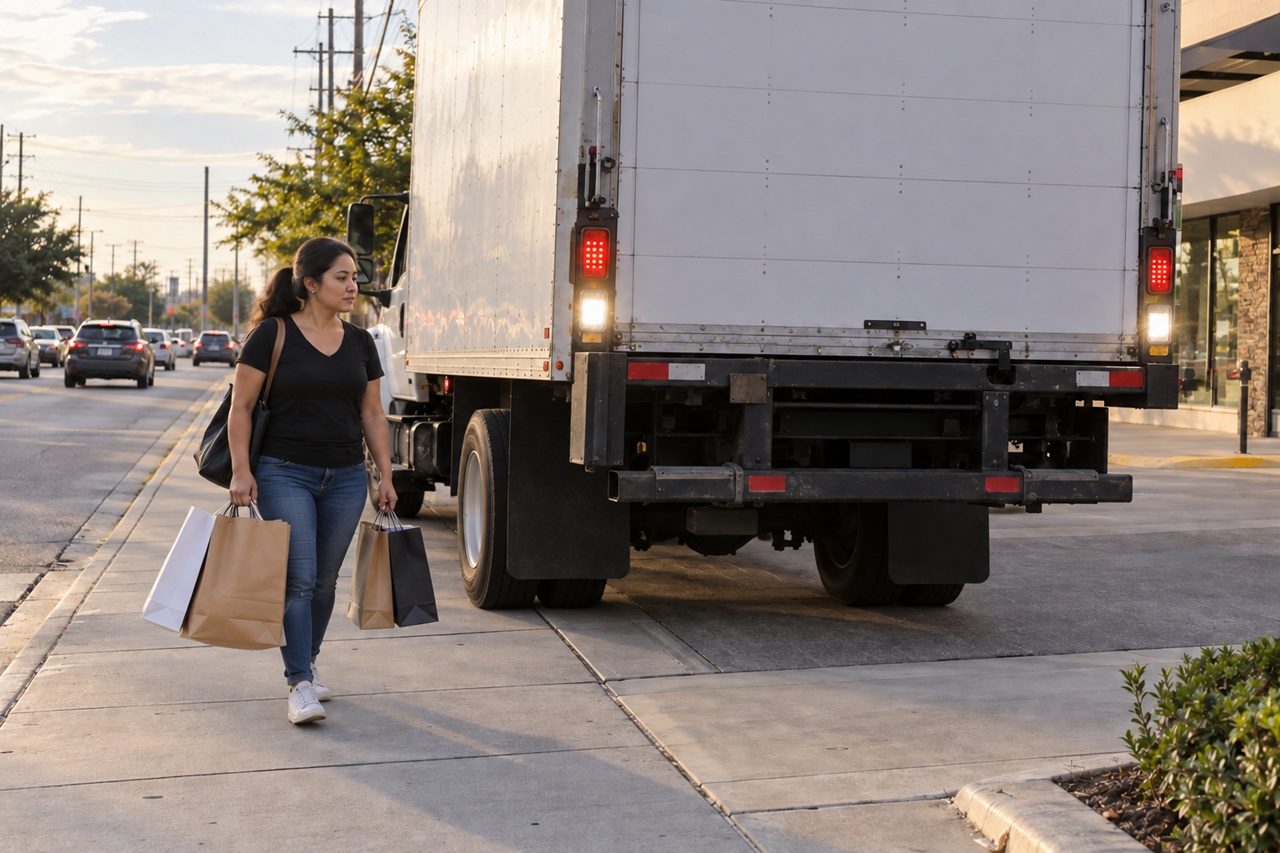
When a commercial truck backs into a pedestrian or cyclist in Texas, the driver is usually responsible, but rarely alone. Box trucks, garbage trucks, and 18-wheelers have large blind zones behind them, and most aren't required to carry the backup cameras found on passenger cars. A Houston pedestrian accident claim after a backing crash often depends on who had the power to make that maneuver safer.
That list can include the driver's employer, a business that controls a loading dock, a maintenance shop, or a city that runs garbage trucks. Each one carries its own insurance, rules, and deadlines. At Smith & Hassler, our Houston truck accident lawyers look at every party tied to the truck, its job, and the property where the crash happened.
|
At a Glance
|
What Does Texas Law Require Before a Truck Driver Backs Up?
Texas sets a simple standard for backing up. Under Texas Transportation Code Section 545.415, a driver may not back a vehicle unless the movement can be made safely and without interfering with other traffic. Section 552.008 also requires due care to avoid hitting a pedestrian on a roadway and a horn warning when necessary. A cyclist has the same rights as any other driver.
When a driver breaks a safety statute and someone gets hurt, the violation can support a claim for negligence per se. That means the injured person may not need to prove separately that the driver acted unreasonably, because the statute already sets the standard. The driver and the trucking company still get to argue about causation and fault, but the starting point favors the person who was hit.
Many backing crashes, though, happen in parking lots and at loading docks. Texas's rules of the road generally apply only on highways and streets, so those crashes usually turn on ordinary negligence. The question becomes whether a careful driver would have checked the mirrors, walked around the truck, used a spotter, or simply waited. Those are the same questions that come up in many Texas parking lot accidents.
Why Commercial Trucks Are So Dangerous in Reverse
A driver sitting high in the cab of a box truck or garbage truck often can't see anyone standing directly behind it. Federal Motor Vehicle Safety Standard 111 has required rearview cameras on new passenger cars, pickups, and other vehicles of 10,000 pounds or less since May 2018. Heavier trucks fall outside that mandate, so many still rely on side mirrors that leave a wide blind zone behind the bumper.
Some industries already treat backing as a known hazard. On off-highway construction sites, OSHA rules bar employers from using vehicles with an obstructed rear view unless they have a reverse alarm loud enough to hear or back up only on an observer's signal. Those rules protect workers, but they show the danger is well understood. A company that sends delivery trucks into crowded neighborhoods without spotters or working alarms may struggle to defend that choice.
Who Can Be Held Liable for a Truck Backing Crash?
Liability in a backing crash follows control, meaning who controlled the truck, the driver, the equipment, or the place where it happened. Here are the parties that most often share responsibility.
- The Truck Driver: A driver who backs up without checking mirrors, sounding the horn, or confirming a clear path can be directly responsible for the injuries.
- The Employer or Motor Carrier: Employers are generally liable for crashes their drivers cause on the job, and federal leasing rules make carriers responsible for trucks they lease.
- The Property Owner or Business: A warehouse, store, or contractor that controls a loading area may share fault for poor lighting, no barriers, or no spotter policy.
- The Maintenance Company: A shop that left a backup alarm, camera, or mirror broken can share responsibility when that failure helped cause the crash.
- A City or Other Government Unit: Garbage trucks and other public vehicles fall under the Texas Tort Claims Act, which has its own damage caps and notice rules.
Naming every responsible party matters because each one may carry separate insurance. A driver's personal auto policy may exclude business use, while the company's commercial vehicle coverage may offer far more. Questions about whether the driver was working at the time, or whether a contractor controlled the dock, can decide which policy pays. Missing one party early can leave money on the table later.
When a City Garbage Truck Backs Into Someone
Government trucks follow a different set of rules. Under the Texas Tort Claims Act, a city can be liable when an employee causes an injury while driving a motor-driven vehicle on the job. That waiver covers city garbage trucks, maintenance trucks, and similar vehicles. Recovery against a city, however, is capped at $250,000 per person and $500,000 per occurrence for bodily injury or death.
The notice deadlines are even tighter. State law requires notice to a government unit within six months, but city charters can shorten that window. According to the City of Houston Legal Department, its charter requires verified written notice to the mayor and city council within 90 days of the injury. A missed deadline can bar the claim, so a city truck crash needs attention right away.
Evidence That Shows How a Backing Crash Happened
Backing crashes often happen quickly and without many witnesses, so the physical and electronic records carry extra weight. Some of that proof belongs to the trucking company, and some belongs to the business where the truck was parked. The table shows where key evidence usually lives and what it can reveal.
| Evidence | Who Usually Holds It | What It Can Show |
|---|---|---|
| Backup camera or dashcam video | Trucking company | What the driver could see before reversing |
| Telematics and GPS data | Trucking company or fleet vendor | Speed in reverse and how long the truck sat before moving |
| Alarm and mirror maintenance records | Carrier or repair shop | Whether the safety equipment worked |
| Surveillance video | Store, warehouse, or nearby business | The truck's path and where the victim was standing |
| Dock rules and spotter policies | Business that controls the property | Whether a spotter or barrier was required |
| Driver training files | Employer | Whether the driver was taught safe backing procedures |
Much of this evidence doesn't last long. Business security systems often record over old footage, and fleet data can be overwritten on a regular cycle. A preservation letter sent soon after the crash puts the trucking company and property owner on notice to keep it. Dashcam and surveillance video can be especially powerful because it shows exactly what happened in the seconds before impact.
Can a Pedestrian or Cyclist Be Blamed for a Backing Crash?
Insurance companies often try. They may argue that a pedestrian walked behind a truck that was already reversing, or that a cyclist rode too close to a loading zone. Texas uses a modified comparative fault system under Civil Practice and Remedies Code Section 33.001. An injured person can recover as long as their share of responsibility is 50% or less, with damages reduced by that percentage.
Those arguments rarely change the driver's core duty. The law puts the burden on the driver backing up to make sure the movement is safe. Evidence about the alarm, the mirrors, and the driver's view can counter an unfair share of the blame. The same principles apply when determining fault in a bicycle accident. Most of these claims must also be filed within two years of the crash.
Building the Case Against Everyone Behind the Wheel and the Fleet
A backing crash can leave a pedestrian or cyclist with crushed bones, head injuries, or months of recovery. The driver's insurer may move quickly to settle before anyone looks at the employer, the property owner, or the city. Our attorneys have recovered more than $1 billion for injured Texans, including $2.3 million for a client in an 18-wheeler accident case. We also serve clients in English and Spanish from offices across the Houston area.
We handle these cases on a contingency fee basis, so there are no upfront costs to get started. If a truck backed into you or someone you love, reach out to our team for a free consultation. We can track down every responsible party and the evidence that shows how the crash happened.
"I was hit by a car, called Smith and Hassler, and explained all that had happened to me and that I didn't have insurance. They handled everything. This was my first experience with having to seek legal help, and it was not an unpleasant experience. Thanks to Smith and Hassler, all my expenses were taken care of." — Audrey B., ⭐⭐⭐⭐⭐