
Truck Driver Fatigue in Texas: How Hours-of-Service Violations Lead to Catastrophic Crashes
Texas truck accident lawyers explain how the legal process works
Truck drivers in Texas haul freight across long, demanding routes that span from Houston to Dallas, San Antonio, and beyond. Unfortunately, some companies push their drivers to meet unrealistic delivery schedules. When they do, exhaustion – and truck accidents – become inevitable.
Texas consistently ranks as the state with the most commercial truck crashes each year. And many of these wrecks share a common factor – tired drivers who were behind the wheel far longer than the law allows. Truck driver fatigue can dull reaction times, impair judgment, and make an 18-wheeler as dangerous as a vehicle operated by a drunk driver.
That’s why hours-of-service rules exist – to limit how long commercial truck drivers are on the road without taking a rest break. Our Houston truck accident lawyers at Smith & Hassler explain how this law works and why hours-of-service violations often cause serious truck crashes, especially 18-wheeler truck accidents.
What are the federal hours-of-service rules for truck drivers?
Federal law limits how long commercial truck drivers can legally stay on the road without taking mandatory rest breaks. These rules, known as hours-of-service (HOS) regulations, can be found in Title 49, Part 395 of the Code of Federal Regulations, a large collection of rules and regulations governing commercial truck drivers nationwide.
Under the HOS framework, most long-haul truck drivers must follow these rules:
- 11-hour driving limit – Drivers can drive a maximum of 11 hours after 10 consecutive hours off duty.
- 14-hour work window – The 11 hours of driving must fall within a 14-hour on-duty period. Once 14 hours pass, drivers cannot drive again until after another 10-hour break.
- 30-minute rest break – Drivers must take a 30-minute break after 8 consecutive hours of driving.
- 60/70-hour limit – Over seven or eight days, a driver’s total on-duty time cannot exceed 60 or 70 hours, depending on their schedule.
These limits exist because driver fatigue doesn’t just slow reaction time. Lack of sleep has the same negative effects as alcohol consumption. A driver who has been awake for more than 18 hours can be as impaired as someone with a blood alcohol content of 0.08 percent, the legal threshold for drunk driving.
Why do hours-of-service violations still happen?
Despite clear rules and regulations, many commercial truck drivers and their employers often try to find ways to work around them. Why? Truck drivers and trucking companies often face intense pressure to deliver cargo on time, even if it means breaking the law and driving to the point of exhaustion.
Some commercial truck drivers feel they have no choice but to keep driving even when they’re exhausted and can barely keep their eyes open, especially when their pay depends on mileage rather than hourly wages. In other cases, dispatchers overbook drivers, forcing them to work unrealistic hours that violate HOS laws.
When that happens, drivers may:
- Falsify logbooks or electronic records to hide excess hours.
- Skip mandatory rest breaks to reach destinations faster.
- Use stimulants or caffeine to stay awake beyond safe limits.
Multi-vehicle freeway crash highlights the consequences of driver fatigue
In one case, Smith & Hassler attorney Daragh Carter filed suit in Harris County Civil District Court on behalf of two clients who were injured in a serious three-vehicle crash caused by an exhausted driver. Through discovery responses, the defendant admitted that he fell asleep behind the wheel while driving on the freeway, which was a mistake that had devastating consequences.
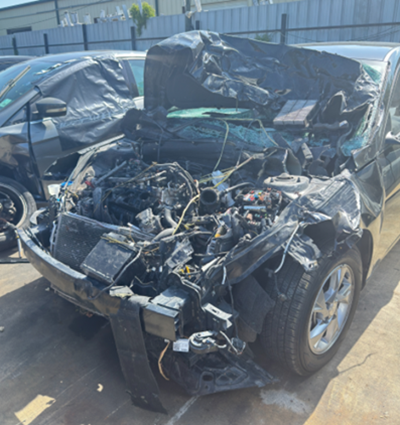
The driver’s vehicle first slammed into the rear of a big rig that was stopped on the shoulder. The impact sent his car careening out of control, striking our clients’ vehicle and causing major front-end damage. Both clients were transported to the hospital with significant injuries.
While this crash didn’t involve a fatigued trucker, it shows just how dangerous drowsy driving can be, even in a smaller passenger vehicle. Now imagine the destruction that can result when a tired driver is behind the wheel of an 80,000-pound tractor-trailer. Fatigue behind the wheel of a commercial truck can multiply the force of impact, turning what might otherwise be a survivable crash into a catastrophic one.
Who investigates hours-of-service violations in Texas?
After a serious truck accident in Texas, several agencies and private investigators may look into whether the truck driver or trucking company violated federal Hours-of-Service (HOS) regulations. These investigations are often detailed and time-sensitive, since electronic data can be altered or deleted if not preserved quickly. Investigations may be conducted by:
- The Federal Motor Carrier Safety Administration (FMCSA) – At the federal level, the FMCSA oversees commercial motor carrier safety and has the authority to inspect truck driver logbooks, electronic logging devices (ELDs), and company records.
- The Texas Department of Public Safety (DPS) – This state agency plays a key role in enforcing state and federal trucking laws on highways across Texas.
- The Texas Highway Patrol – When a fatal or catastrophic truck crash occurs in Texas, a trooper from the Texas Highway Patrol often investigates, especially if the accident occurs on a rural road or highway.
- Local police – Along with Texas Highway Patrol troopers, local police officers in Texas often investigate many serious or fatal truck accidents.
Along with these official investigations, many private investigations also occur after a truck accident caused by a tired truck driver. These private investigations are often conducted by:
- Insurance companies for all parties involved in the crash.
- Trucking companies, especially if their truck driver fell asleep at the wheel.
- Accident reconstruction experts hired by insurance companies or trucking companies.
- Lawyers representing the insurance companies, the trucking company, and the injury victims.
Your truck accident attorney can and should investigate your crash. In particular, if you decide to take legal action, your lawyer can use subpoenas and discovery requests to uncover evidence that might otherwise stay hidden.
How do investigators uncover hours-of-service violations?
Truck accident investigations are complex and often require quick action to preserve key evidence. In a fatigue-related truck accident, many investigations focus on the driver’s behavior and the trucking company’s records.
Common sources of evidence that a truck driver violated hours-of-service rules:
- Electronic logging devices (ELDs) record driving time automatically and can reveal inconsistencies when compared to GPS data or truck driver statements.
- GPS and telematics data provide truck location and speed information to verify whether the truck driver complied with hours-of-service regulations.
- Fuel and toll receipts show travel times that can confirm or disprove log entries.
- Shipping manifests and bills of lading establish loading and delivery times to see whether a truck driver could have realistically followed such a schedule without violating HOS rules.
- Witness testimony and surveillance footage can confirm whether the truck driver appeared drowsy or fatigued before the crash.
- Comparing paper and digital logs can detect discrepancies that signal falsified entries.
- Interviewing dispatchers and co-drivers can reveal information about company pressures or unrealistic delivery schedules.
- Company communications, such as emails or text messages, can show management encouraging unsafe practices.
- Accident reconstruction and fatigue experts can interpret data and confirm how exhaustion likely contributed to the crash.
What makes fatigue-related truck crashes so dangerous?
Fatigued driving affects every aspect of a driver’s ability to operate safely. Drowsy drivers react more slowly, drift between lanes, and often fail to brake in time to avoid collisions. As a result, many asleep-at-the-wheel truck accidents result in high-speed collisions since tired drivers make no attempt to slow down before the crash.
For an 80,000-pound, fully loaded tractor-trailer, even a momentary lapse can cause a devastating truck accident. Fatigue is linked to many different types of serious truck accidents, including:
- Rear-end collisions – A tired truck driver may not notice slowing traffic ahead in time to stop.
- Lane-departure or head-on crashes – Microsleep episodes can cause a truck to veer into oncoming lanes, resulting in a serious head-on collision.
- Jackknife accidents – Overcorrecting after drifting can lead to complete loss of control, causing a tractor-trailer to jackknife.
- Rollover accidents – Truck drivers who fall asleep at the wheel often lose control of the truck, which can roll over and collide with other vehicles at high speed.
Are trucking companies responsible for driver fatigue?
In many cases, yes. Trucking companies are legally responsible for making sure their drivers comply with federal safety rules. When a company pressures drivers to break HOS regulations – whether explicitly or through unrealistic delivery schedules – it can be held liable for negligence.
Evidence of corporate misconduct can include:
- Dispatch emails or texts instructing drivers to meet impossible deadlines.
- Pay structures that reward early delivery times over safety compliance.
- Failure to monitor drivers to make sure they’re complying with HOS regulations.
- Internal audits, inspection reports, and hiring records that reveal a pattern of hiring or retaining truck drivers who don’t comply with HOS rules.
How can falsified logbooks and ELD records be exposed?
Before ELDs became mandatory, truck drivers kept handwritten logbooks outlining their truck route, miles driven, and the exact time of mandatory rest breaks. Many truck drivers falsified these records and wrote down breaks they never actually took.
Digital logbook systems have reduced abuse, but manipulation still happens. Investigators often find errors between ELD data, GPS pings, and delivery timestamps – all clear signs of an HOS violation.
Trucking companies may also tamper with records or ignore warning alerts from their monitoring systems. When such actions are proven, both the driver and company can be held legally responsible for truck accidents based on negligence and safety violations.
What role do Texas and federal courts play in fatigue-related cases?
Truck accident lawsuits involving fatigue rely on both state negligence laws and federal safety regulations. Violating FMCSA hours-of-service rules serves as strong evidence of negligence because these rules exist to protect public safety.
If you decide to file a truck accident lawsuit seeking damages (the legal term for compensation for financial losses), the judge or jury deciding your case will often take into account certain evidence when deciding whether the truck driver violated state or federal laws when they caused your accident. Courts may consider evidence such as:
- Hours-of-service logs that show excessive driving time.
- Testimony from accident reconstruction experts that provides a detailed crash timeline.
- Data from onboard truck computers, including GPS and engine logs.
- Employment records that show dispatcher or corporate pressure to ignore HOS regulations in favor of faster delivery times.
What compensation is available to victims of fatigued truck drivers?
Victims of truck driver fatigue crashes often face lifelong consequences due to serious injuries. Through a civil claim, injured individuals can demand compensation for all financial losses associated with the accident, including money for:
- Medical expenses – Hospital bills, surgeries, rehabilitation, long-term care, follow-up doctor’s appointments, and future surgical procedures.
- Lost income – Compensation for missed work while recovering from the accident.
- Reduced earning capacity – Severe injuries often prevent injury victims from returning to work.
- Pain and suffering – Physical pain, especially chronic pain, and emotional distress.
- Property damage – Vehicle repair or replacement costs.
- Wrongful death damages – Compensation for funeral costs and loss of companionship.
In extreme cases, where deliberate rule violations or reckless corporate behavior are proven, courts may also award punitive damages, which is additional compensation designed to punish the at-fault party and deter such misconduct in the future.
Our experienced Texas truck accident lawyers can help
Fatigue-related truck crashes are rarely accidents. They are often the result of choices made by trucking companies and drivers who prioritize profits over safety. When this happens, negligent trucking companies and reckless truck drivers should be held accountable for their actions.
This is why it’s important for injury victims to have an experienced Texas truck accident lawyer handling their case. Our dedicated legal team at Smith & Hassler has years of experience handling such complex legal cases. We know how to uncover HOS violations, build a strong legal case based on solid evidence, and hold all responsible parties accountable for their actions.
To learn more about your legal options after a truck accident caused by driver fatigue, contact our law firm and schedule a free case evaluation with a Texas truck accident attorney you can trust.
Click here for a printable PDF of this article, “Truck Driver Fatigue in Texas: How Hours-of-Service Violations Lead to Catastrophic Crashes.”